
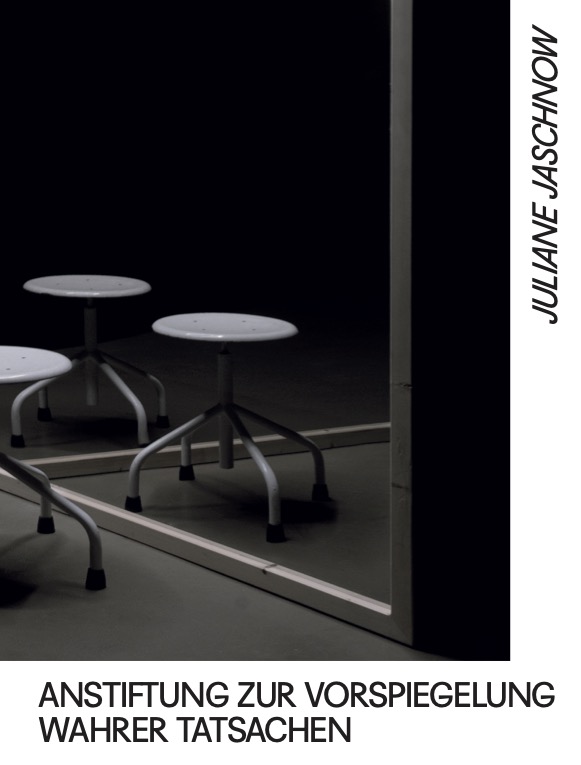
The catalogue “Anstiftung zur Vorspiegelung wahrer Tatsachen (Incitement to Misrepresentation of True Facts)” is published on the occasion of Juliane Jaschnow’s exhibition at D21 Kunstraum Leipzig and accompanies the exhibition project as an independent publication. Against the backdrop of the annual theme “Concerning Power,” it deepens the questions addressed in the exhibition concerning images of political power, mechanisms of propaganda, and the role of collective memory. Extending beyond the temporal and spatial limits of the exhibition, the catalogue seeks to document Juliane Jaschnow’s artistic practice and to expand it through a curatorial perspective.
The works reveal the artist’s search for meaning, which emanates from the image. The assembled installation of three work complexes consists of references to iconic photos from European history, replicas of objects from these photos, investigations in various video works, and, with the help of aesthetic ‘further education’, traces that viewers can and must follow and respond to.
The catalogue follows the chronological order in which the works were created and begins with views of the first complex, “Recapitulating.” The focus of the video work Rekapitulieren is a replica of the Berlin Reichstag erected by the Russian Ministry of Defense in the military-patriotic theme park Park Patriot near Moscow. In the spring of 2017, hundreds of extras reconstructed the iconic key scene of Russian war remembrance—the storming of the Reichstag in May 1945 and the raising of the Soviet flag on the building. This reenactment forms the starting point for Juliane Jaschnow’s examination of German-Russian memory culture. The work, which includes a video installation, objects, and print elements, focuses on collective images of history and memory, their identity-forming role, and the significance of patriotic education in today’s Russia.
The second complex of works, the multi-part piece “with friendly applause” (2023/24), deals with the continuities of Russia’s propagandistic staging, examining forms and backgrounds of power representation as well as mechanisms of disinformation and deception. The central object of this complex of works is a replica of the redesigned curtains in the Kremlin’s reception hall, where foreign state guests, among others, are received.
The title of this complex of works is taken from a 1993 newspaper report in Neues Deutschland, which reports that Putin, as deputy mayor of St. Petersburg, advocated a “military dictatorship based on the Chilean model” for Russia in a speech to German guests, and that the German politicians and entrepreneurs present responded to these words with “friendly applause.” The original article is displayed in a frame.
In her new work, “Incitement to False Pretences” (2025), Juliane Jaschnow examines the ongoing sacralisation of Russian state power. In various videos presented with reference to the political context via speech and teleprompters, she examines the role of the Orthodox faith and shamanism in the ideological legitimization of the “special military operation” in Ukraine—and its embedding in a religious-nationalist narrative of sacrifice and heroism for Russia. She also focuses on supernatural practices that are used as individual coping strategies in times of collective uncertainty and warlike reality.
Regardless of the function of the images that the artist engages with or creates herself, her method remains in the image—whether it is decoded or recreated. Juliane Jaschnow’s artistic practice develops an immensely multi-layered work that can be read on many levels, turning viewers into detectives of their own culture, other cultures, cultural memories, power structures, and the like. Despite the fascination of this ramified network of themes and associations, thoughts and methods that opens up in the three complexes of works, her working method is as complex as it is simple: Juliane Jaschnow’s artistic practice is an in-depth analysis of the medium of the image in the past and present.
The catalogue is published in German and English and is available at D21 Kunstraum Leipzig or can be ordered via office@d21-leipzig.de